
Waste
The urban waste sector
The public cleaning and urban waste management sector involves the provision of essential services that protect the population from public health problems and prevent soil, water, and air pollution, being strategic for ensuring the quality of life and the sustainable future of cities.
Generally, these services typically involve street sweeping, collection, transportation, treatment, and final disposal of urban waste. For all these services to be carried out in an integrated, continuous, and efficient manner, there are responsibilities that must be shared between citizens, companies, and the public authorities.
The public authorities are responsible for developing an integrated urban waste management plan to be implemented with short-, medium-, and long-term actions, considering available financial resources, existing technologies, available areas for operational units (garages, treatment and final disposal units), and the level of education and awareness of the population, which, among other responsibilities, should: not litter streets and public areas, correctly separate waste at home, store waste in separate bags, pay for services rendered on time, etc.
The public authorities are also responsible for environmental licensing and implementation of the different stages planned in the integrated waste management plan. The services foreseen in the plan can be implemented directly by the public authorities, with their own teams and equipment, or indirectly, through a bidding process for the outsourcing of public services that foresees the contracting of company(ies) responsible for providing the services with their own team and equipment, in exchange for a monthly remuneration for the services performed.
Essential Legal Aspects
New public policies have recently been established in Brazil, especially Resolution No. 187 of the ANA (National Water and Basic Sanitation Agency), which approved Reference Standard No. 07/2024 (NR 07/2024), which defines the general conditions for the provision of urban cleaning services, management and treatment of urban waste, and establishes the guidelines that allow the implementation of all the principles foreseen in Federal Law No. 12.305/2010.
A definitive boost for the recycling sector was given with the enactment of Law No. 15,394/26, which amends federal tax legislation and eliminates double taxation, exempting the sale of recyclable materials from certain taxes (PIS/Pasep and Cofins) and authorizing the use of tax credits in the purchase of recyclable materials, provided that the company is taxed under the real profit regime.
Current reality of the urban waste sector in Brazil
Unlike developed countries, in Brazil and other developing countries, the recycling rates of household waste are extremely low, less than 5%.
In Brazilian cities where door-to-door "selective collection" services exist, it was observed that, on average, there is a "contamination" rate of recyclables (with rejects and organic fraction) of 40% (source: SLU – DF), demonstrating the very low level of public awareness regarding the correct separation of waste in their homes.
Despite all the potential social, environmental, and economic benefits, in Brazil the segment of industrial treatment units that allow for the valorization of urban waste, maximizing material recovery, generating renewable energy, and reducing GHG emissions, is still in its early stages.
The flowchart below represents the main technological routes that comply with existing environmental legislation and technical standards and are viable for implementation in countries like Brazil, where the collection of unsorted waste still predominates; that is, selective collection of different fractions of household waste does not yet exist, or where it does exist, it is still in its early stages.
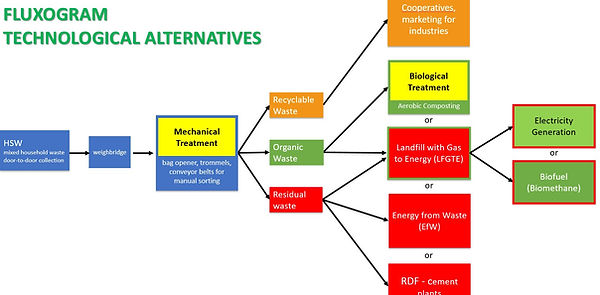
The sustainability solutions implemented by Aiesse Ambiental adopt technologies that are appropriate to the local reality of each project.
We avoid, as much as possible, sending unsorted waste to landfills without first subjecting it to Mechanical Treatment (MT). This allows for the valorization of each fraction (recyclable, organic, and rejects) of unsorted household waste, thus enabling the recovery of materials on an industrial scale, the generation of renewable energy, the reduction of GHG emissions, as well as increasing the lifespan of current landfills and reducing deforestation by avoiding the need for future landfill areas.
As an example, we cite one of the projects developed by Aiesse Ambiental in partnership with leading national and global companies in their respective sectors, which foresees the diversion of 90% of landfill waste, generating 57 MW of renewable energy, enough to supply 100,000 homes for 60 years.
We believe in the potential of transforming recyclable waste into a source of secondary raw materials as input for new industries, in the recovery of the organic fraction for agricultural or energy purposes, and in the energy recovery of rejects as a way to guarantee a secure and stable energy supply for residential, commercial and/or public building consumption, or even for the electrification of fleets and urban transport.


Aiesse Ambiental actively participates in initiatives promoting the sustainable management of urban waste in Brazil, both as coordinator of the Waste / Energy from Waste (EfW) committee of the Brazilian Association of Industrial Engineering (ABEMI), and as a member of the technical committee of the Valoriza Resíduos Institute by ABLP.
To learn more about the range of social, environmental, and economic benefits achieved through the sustainable urban waste management projects developed and implemented by Aiesse Ambiental, click the button below.