
Case
Success case
The Sustainable Business COP 30 (SB COP) is a major global initiative led by the Brazilian National Confederation of Industry (CNI) to promote the engagement of the business sector in combating climate change and accelerating the transition to a low-carbon economy.

SBCOP video - July/2025

Mechanical Biological Treatment (MBT) Unit in Ceilândia, Federal District
The case study submitted to the Sustainable Business COP 30 (SB COP) by Aiesse Ambiental was recognized as an innovative, scalable solution that generates social, environmental, and economic results aligned with the Paris Agreement, an international treaty that aims to limit global warming to less than 2°C compared to pre-industrial levels.
The case demonstrates, in practice, that it is possible to recover recyclable materials and the organic fraction even when they are all collected mixed together (= undifferentiated waste) in a single "garbage bag," the usual practice in countries like Brazil, since the population's adherence to door-to-door selective collection programs is still very low.
Since the population does not separate the different fractions (recyclables, organics, and rejects) in their homes, the undifferentiated waste collected must then be sent to industrial Mechanical Treatment units so that the undifferentiated waste can be separated into the three main fractions (recyclables, organics, and rejects) after the garbage bags are mechanically opened (using a bag opener) and sifted.
As shown in the images below, after sifting, the recyclable fraction is directed to the manual sorting stage carried out by members of the cooperatives, while the organic fraction is sent to the composting yard.
Mechanical Treatment:

bag opener and sieves
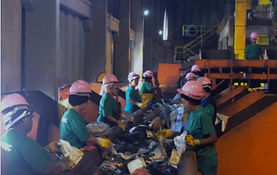
manual sorting
Biological Treatment:

aerobic composting
Depending on the project, the manual sorting stage can still be complemented with the use of automated sorting technology with the aid of optical readers, which allows for increased efficiency in the separation of materials.
This case study was implemented in Ceilândia-DF, near a region with strong demand for the use of organic compost as an input to increase agricultural production. Therefore, Aiesse Ambiental prioritized Biological Treatment (BT) of the organic fraction through aerobic composting on an industrial scale, a biological process that accelerates the decomposition of organic matter and avoids unpleasant odors for the neighborhood, accompanied by technological control that ensures the quality of the organic compost produced, which is certified by periodic tests carried out by independent laboratories.
The videos below present details of the operation of the TMB industrial unit, a case study submitted by Aiesse Ambiental to SB COP.
This is a viable and sustainable technology that has been in operational scale for more than 10 (ten) years, attesting to its total viability in Brazil, and it complies with existing environmental legislation and technical standards, in addition to following the guidelines established by the resolutions of the National Water and Sanitation Agency (ANA).
New Mechanical Treatment (MT) units need to be implemented in metropolitan regions of Brazil and other developing countries in order to maximize material recovery rates, enable the generation of renewable energy, and reduce greenhouse gas (GHG) emissions, especially methane, one of the major contributors to climate change.
Positive environmental impact

Landfill Diversion
44%
Of the 650 tons/day of unsorted waste received are diverted from the landfill

Annual emission reduction (year 10)
34,800
tCO2e

Production of certified organic compost
48,000
tons/year