


Sustainability solutions for urban environmental challenges
The intensification of global warming has been caused by the accumulation of greenhouse gas (GHG) emissions, mainly methane, leading to increasingly frequent extreme weather events that alter rainfall patterns and droughts in certain regions, or cause increasingly intense heat and cold waves in others.
Aiesse Ambiental connects local and global expertise to implement sustainability solutions that enable the decarbonization of the waste management sector, focusing on the use of technologies that allow for the valorization of urban waste on an industrial scale, enabling the recovery of materials, the generation of renewable energy, and the reduction of GHG emissions, fundamental pillars of the Circular Economy.
About us
Aiesse Ambiental
For three decades, Aiesse Ambiental's experienced technical team has participated in the development of projects and the implementation of major municipal waste management contracts, in which the valorization of waste has become an increasing priority, whether for social, environmental or economic reasons.
By utilizing viable, proven technologies that are fully tailored to local conditions, we have achieved results that promote the recovery of materials on an industrial scale and enable the generation of renewable energy, in addition to numerous other benefits for society as a whole.

Vision
The urban waste management sector can (and should) play a decisive role in reversing global warming through the development of projects that reduce greenhouse gas (GHG) emissions.

Mission
Implement industrial treatment facilities using viable and sustainable technologies that enable the recovery and valorization of the different fractions of urban waste (recyclables, organic waste, and residual waste), serving as a benchmark for climate change mitigation initiatives in the public sanitation sector.

Case
Success case
The Sustainable Business COP 30 (SB COP) is a major global initiative led by the Brazilian National Confederation of Industry (CNI) to promote the engagement of the business sector in combating climate change and accelerating the transition to a low-carbon economy.
SBCOP video - July/2025
The case study submitted to the Sustainable Business COP 30 (SB COP) by Aiesse Ambiental was recognized as an innovative, scalable solution that generates social, environmental, and economic results aligned with the Paris Agreement, an international treaty that aims to limit global warming to less than 2°C compared to pre-industrial levels.
Mechanical Treatment:

bag opener and screen
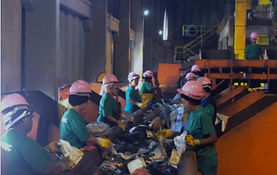
manual sorting
Biological Treatment:

aerobic composting
We understand that this success story can (and should) be disseminated not only in the main metropolitan regions of Brazil, but also in other emerging and developing countries, in order to maximize material recovery rates, enable the generation of renewable energy, and reduce greenhouse gas (GHG) emissions, especially methane.
Methane
Methane (CH4) emissions
Despite its much smaller presence in the atmosphere compared to carbon dioxide (CO2), methane has a much greater ability to retain heat than CO2, being 80 times greater in the first two decades after its emission into the atmosphere, and about 30 times greater after 100 years in the atmosphere. Due to this greater capacity to retain heat, methane (CH4) is considered one of the most potent greenhouse gases (GHG) and a major contributor to global warming.

Waste
The urban waste sector
The public cleaning and urban waste management sector involves the provision of essential services that protect the population from public health problems and prevent soil, water, and air pollution, being strategic for ensuring quality of life and the sustainable future of cities. In general, these services involve street sweeping, collection, transportation, treatment, and final disposal of urban waste. For all these services to be carried out in an integrated, continuous, and efficient manner, there are responsibilities that must be shared between citizens, companies, and the public authorities. Aiesse Ambiental actively participates in initiatives promoting the sustainable management of urban waste in Brazil, both as coordinator of the Waste / Energy from Waste (EfW) committee of the Brazilian Association of Industrial Engineering (ABEMI), and as a member of the technical committee of the Valoriza Resíduos Institute by ABLP.


Certified organic compost
Aerial view of TMB plan.